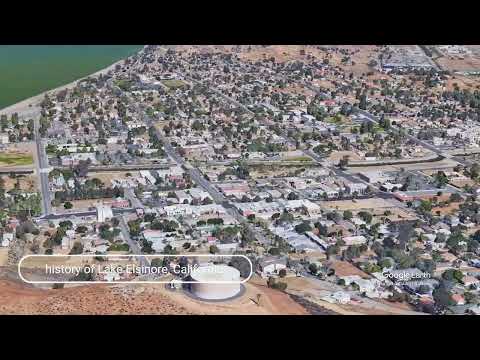
Lake Elsinore, California
Lake Elsinore is a city in western Riverside County, California, United States. Established as a city in 1888, it is on the shore of Lake Elsinore, a natural freshwater lake about 3,000 acres (1,200 ha) in size. The city has grown from a small resort town in the late 19th and early 20th centuries to a suburban city with a population of 70,265 as of the 2020 census.
Native Americans have long lived in the Elsinore Valley. The Luiseño people were the earliest known inhabitants. Their pictographs can be found on rocks on the Santa Ana Mountains and in Temescal Valley, and artifacts have been found all around Lake Elsinore and in the local canyons and hills. Overlooked by the expedition of Juan Bautista de Anza, the largest natural lake in Southern California was first seen by Spanish Franciscan padre Juan Santiago, exploring eastward from the Mission San Juan Capistrano in 1797. In 1810, the water level of the Laguna Grande was first described by a traveler as being little more than a swamp about a mile long. Later in the early 19th century, the lake grew larger, providing a spot to camp and water their animals for Mexican rancheros, American trappers, the expedition of John C. Frémont, and the immigrants during the California gold rush as they traveled along the southern shore of the lake on what later became the Southern Emigrant Trail and the route of the Butterfield Overland Mail.
According to the United States Census Bureau, the city has a total area of 43.5 sq mi (112.7 km2) of which 5.3 sq mi (13.7 km2), or 12.13%, are covered by water. Lake Elsinore, originally Laguna Grande, is the largest natural freshwater lake in Southern California and is situated at the lowest point within the 750-square-mile (1,900 km2) San Jacinto River watershed at the terminus of the San Jacinto River, where its headwaters are found on the western slopes of San Jacinto Peak with its North Fork, and Lake Hemet with its South Fork. Lake levels are healthy at 1,244 feet (379 m) above sea level with a volume of 30,000 acre⋅ft (37 Gl) that often fluctuate, although much has been done recently to prevent the lake from drying up, flooding, or becoming stagnant. At 1,255 feet (383 m), the lake would spill into the outflow channel on its northeastern shore, known properly as Temescal Wash, flowing northwest along I-15, which feeds Temescal Creek, which dumps into the Santa Ana River just northwest of the City of Corona. It then flows to Orange County, out to the Pacific Ocean just south of Huntington State Beach.
Districts
Lake Elsinore encompasses a large geographical area. To better distinguish the wide range of neighborhoods, the city is organized into 11 districts; each beholds its own unique geography, culture, age, and history, which together make Lake Elsinore a very diverse and culturally rich city. They are the Alberhill, Ballpark, Business, Country Club Heights, East Lake, Historic, Lake Edge, Lake Elsinore Hills, Lake View, North Peak, and Riverview Districts. The Alberhill District is characterized by rolling terrain, vacant land, and the newly constructed Alberhill Ranch neighborhood. Much of the topography in the central areas, east and west of Lake Street, has been substantially altered as a result of the Alberhill District's long history of extractive/mining activities. Mining operations in the Alberhill District began at Terra Cotta roughly the same time the region's first railroad, the California Southern Railroad, was completed in the 1880s. A spur of the railroad originally built to Terra Cotta was extended into the central portion of the Alberhill District. The Atchison, Topeka, and Santa Fe Railroad built a line up from Corona through Alberhill to Elsinore after the line through Railroad Canyon was washed out in the 1920s. These events helped shape the growth of the District. Mining operations for coal and especially clay have continued to exist since the late 19th century, and occupy a significant portion of the Alberhill District. Through the years, Pacific Clay Products Company has purchased the local mines and has become the sole operating clay mine in the region.
Climate
Lake Elsinore has a mild semi-arid climate (Köppen climate classification BSk/BSh), with hot, almost rainless summers and mild, wetter winters. While too dry for this classification, its thermal regime and precipitation distribution resembles that of a hot-summer Mediterranean climate (Köppen Csa), which is present in many surrounding areas. On average, the hottest month is July, and the coolest month is December. The highest recorded temperature was 118 °F (47.8 °C), first recorded on August 12, 1933, and the lowest recorded temperature was 10 °F (−12.2 °C) on December 30, 1974. The maximum average precipitation occurs in January with 75 millimetres (3.0 inches), and the minimum average precipitation in June with 1.8 millimetres (0.071 inches), although less than half of all Junes, Julies, Augusts, and Septembers record any precipitation whatsoever. The greatest amount of precipitation ever received in one day was 5.28 inches (134 mm), on February 15, 1927. Snowfall only occurs in April with 0.51 centimetres (0.20 inches).
2020 census
As of the 2020 census, Lake Elsinore had a population of 70,265, with a population density of 1,837.6 inhabitants per square mile (709.5/km2). The racial makeup was 39.5% White, 6.8% African American, 1.5% Native American, 7.4% Asian, 0.5% Pacific Islander, 25.3% from other races, and 18.9% from two or more races; Hispanic or Latino residents of any race were 51.0% of the population. The census reported that 99.9% of the population lived in households, 94 people (0.1%) lived in non-institutionalized group quarters, and no one was institutionalized. 98.1% of residents lived in urban areas, while 1.9% lived in rural areas. There were 20,426 households, of which 47.8% had children under the age of 18 living in them. Of all households, 56.5% were married-couple households, 7.5% were cohabiting couple households, 20.5% had a female householder with no spouse or partner present, and 15.5% had a male householder with no spouse or partner present. About 14.3% of all households were made up of individuals, and 4.6% had someone living alone who was 65 years of age or older. The average household size was 3.44, and there were 16,447 families (80.5% of all households).
2023 ACS 5-year estimates
In 2023, the US Census Bureau estimated that 21.0% of the population was foreign-born. Of all residents aged five years or older, 57.9% spoke only English at home, 35.6% spoke Spanish, 1.9% spoke other Indo-European languages, 4.2% spoke Asian or Pacific Islander languages, and 0.5% spoke other languages. Of those aged 25 or older, 82.9% were high school graduates and 23.0% had a bachelor's degree. The median household income in 2023 was $96,527, and the per capita income was $34,572. About 7.4% of families and 9.4% of the population were below the poverty line.
One of the first outlet centers in California was established in northwestern Lake Elsinore in the late 1990s on Collier Avenue at Nichols Road, just off Interstate 15. The center, known as the Outlets at Lake Elsinore, has a wide variety of retailers, encompassing clothing and shoe stores, eateries, bookstores, perfumeries, home and garden boutiques, and electronics stores. Pacific Clay is among the companies based in Lake Elsinore.
Top employers
According to the city's 2024 Comprehensive Annual Financial Report, the top employers in the city are:
In the California State Legislature, Lake Elsinore is in the 32nd senatorial district, represented by Republican Kelly Seyarto, and in the 63rd Assembly district, represented by Republican Natasha Johnson. In the United States House of Representatives, Lake Elsinore is in California's 41st congressional district, represented by Republican Ken Calvert.
Public safety
The Riverside County Sheriff's Department serves the entire Lake Elsinore Valley (including the nearby community of Lakeland Village and the City of Wildomar) from its regional station in downtown Lake Elsinore. The city once had its own police department, but it was disbanded in 1970 for budgetary reasons. The city of Lake Elsinore contracts for fire and paramedic services with the Riverside County Fire Department through a cooperative agreement with CAL FIRE. Lake Elsinore currently has three paramedic engines and one paramedic truck company operating from its four stations. Fire Station 10 is located downtown next to the post office, which also has two CAL FIRE engines for supplemental protection. Fire Station 85 is located at McVicker Park and Fire Station 94 is located on the east side of the city off of Railroad Canyon Road. Rosetta Canyon Fire Station 97 is located on the northeast side of the city covering the Highway 74 corridor.
Education
Public education within most of the city of Lake Elsinore and the surrounding areas is provided by the Lake Elsinore Unified School District, which serves a student population of about 21,500.[when?][citation needed] The school district has 15 elementary schools, five middle schools, three high schools, and three alternative schools. Lakeside, Temescal Canyon, and Elsinore are the three main high schools of the Lake Elsinore Unified School District. A very small portion of northeastern Lake Elsinore in the Canyon Hills subdivision[citation needed] is located in the Menifee Union School District for grades K-8, and Perris Union High School District for grades 9–12. Another portion of Lake Elsinore is in the Perris Elementary School District and the Perris UHSD for grades 7–12.
Libraries and post office
There are two libraries located in the city: the Lake Elsinore Library at 600 W. Graham Avenue and the Lakeside Library at 32593 Riverside Drive. Both library branches are owned and operated by the Riverside County Library System. The United States Postal Service operates a post office at 500 W. Graham Avenue in Lake Elsinore.
Cemetery
The Elsinore Valley Cemetery District maintains a public cemetery in the city. The cemetery was established in 1891 by Peter Wall. The Jewish Home of Peace Cemetery, a.k.a. Mt. Sinai Memorial Park of Elsinore, is part of the cemetery. The Manker Family Cemetery is an historical cemetery located on the family property. Three known burials are from 1887 to 1902, with evidence of at least one other burial. The four wooden tombstones were burned in a fire.[citation needed]
Roads and highways
Lake Elsinore is served by Interstate 15, which connects the city to points south such as Temecula and San Diego, and to points north such as Corona, Ontario and Las Vegas. Construction is expected to begin around 2025 on a set of toll lanes in the median of Interstate 15 that would extend south from Corona to the northern part of Lake Elsinore. Lake Elsinore is also served by State Route 74, which connects the city with Orange County to the west as well as points east including Perris, the San Jacinto Valley, and the Coachella Valley. Long-range plans include redirecting State Route 74 onto a newer, more direct expressway alignment known as the Ethanac Expressway.
Public transportation
Riverside Transit Agency has several local and express bus routes serving the city of Lake Elsinore, including Routes 8, 9, 40, 205, and 206.
Lake Elsinore Diamond
Lake Elsinore Diamond serves as a site for the Single A baseball team Lake Elsinore Storm, which is a farm team for the San Diego Padres, and was formerly a farm team for the Los Angeles Angels of Anaheim. Also, it held now-disbanded semipro football teams: The Riverside-Elsinore Dolphins of the Western States Football League was active in 1996–98. The stadium hosted the Banning-Elsinore Eagles of the California Football Association, a minor American football league. It used to host the Elsinore-Murrieta Bandits, a semipro soccer team in the 2010s. In 2020, neither football or soccer is played at "the Diamond", but special events, such as concerts with stars such as Willie Nelson and ZZ Top, are held there.
Elsinore Grand Prix
The Elsinore Grand Prix is a dirt-bike race that takes place in and around the Lake Elsinore area. The annual race is usually held in mid-November. The popularity of the event hit its apex in the late 1960s and early 1970s, drawing the likes of dirt-bike greats such as Malcolm Smith and Steve McQueen, to name a few. The race has always been set as an "open" format, meaning anyone can ride; usually only about 200 or so take this event seriously, whereas the rest use it as an opportunity to have fun. In 1971, the documentary movie On Any Sunday by Bruce Brown included scenes from the grand prix. In the mid-1970s the Elsinore Grand Prix hit a snag, none of the big riders were participating, and the event was drawing the wrong crowd, mostly violent motorcycle gangs. The race was cancelled indefinitely soon afterwards. In 1996, several dirt-bike riders, with a hint of nostalgia, decided to lobby the city of Lake Elsinore to revive the Grand Prix. Promising that the violent motorcycle gang crowd drawn to the Grand Prix in the 1970s had gone and that dirt-bike motorcycle riding was more of a family event, the city allowed the event to resume on a provisional basis.
Skateparks
Lake Elsinore offers two skateparks in both north and south of the areas. McVicker Canyon Park was the first city-owned skatepark to be built in Lake Elsinore located between Grand Avenue and McVicker Canyon Park Road. Serenity Park was built in June 2015 and is located on Palomar Road. The city hired Spohn Ranch Skateparks, an internationally renowned firm in Los Angeles, for about $400,000 to design and build the state-of-the-art 8,500-square-foot, open-air plaza that features a peanut-shaped bowl, hip ramps, step-up and quarter-pipes. It is the second city-owned skatepark.