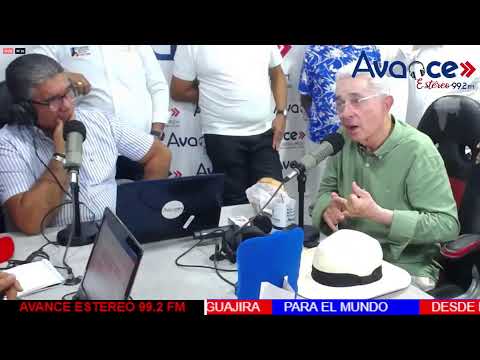
Álvaro Uribe
Álvaro Uribe Vélez is a Colombian politician who served as the 32nd President of Colombia from 7 August 2002 to 7 August 2010. He is a member and leader of the right-wing political party Democratic Center.
Álvaro Uribe was born in Medellín, the oldest of five children. His father, Alberto Uribe Sierra, was a landowner. When he was 10, his family left their Salgar ranch and moved to Medellín. He graduated in 1970 from the Instituto Jorge Robledo, after being expelled from the Medellín Benedictine School for arguing with the Benedictine monks. Uribe studied law at the University of Antioquia and graduated in 1977. His father was killed by a guerrilla group during kidnapping attempt in 1983. After his father's death, Uribe focused on his political career and became a member of the Colombian Liberal Party. Uribe was appointed mayor of Medellín by Antioquia governor Álvaro Villegas in 1982, although he only held the post for five months as he resigned for reasons that remain controversial. According to Villegas, then President Belisario Betancur pressured the governor to ask for his resignation because he claimed that Uribe had links to the Medellín Cartel.
In 1976, at the age of 24, Uribe was Chief of Assets for the Public Utilities of Medellín (Empresas Públicas de Medellín). He served as Secretary General of the Ministry of Labor under Alfonso López Michelsen from 1977 to 1978. During this time, he married Lina Moreno, a philosopher from Medellín[citation needed]. President Julio César Turbay named him Director of Civil Aviation from 1980 to 1982, at the age of 28, after the previous director was assassinated. He was appointed Mayor of Medellín in 1982, but was removed five months later due to alleged connections with drug cartels.
Senator of Colombia
Uribe was elected one of Antioquia's senators from 1986 to 1990, and again from 1990 to 1994. As senator, he served as president of the Seventh Commission[clarification needed] and he supported laws dealing with reform of pensions, labor and social security, as well as promotion of administrative careers, cooperative banking, brown sugar, and protection for women. Some of the legislation later drew criticism, in particular some which reduced the state's responsibility for social security. During his later term, he received official and unofficial awards as one of the "best senators" (1990, 1992 and 1993) and as the senator with the "best legislative initiatives" (1992).
Governor of Antioquia
He was elected governor of the department of Antioquia for the 1995 to 1997 term. During his term, Uribe developed what he described as a model for a communitarian state, where in theory, citizens would participate in the administration's decision making. It was claimed that this model would help improve employment, education, administrative transparency and public security. Within his jurisdiction, Uribe openly supported a national program of licensed private security services that became known as CONVIVIR, which had been created by Decree 356 issued by the Colombian Defense Ministry in February 1994. The groups quickly became controversial – while some reportedly improved security in communities and intelligence coordination with the military, their members were accused of abusing civilians and operated without serious oversight. In 1998, Human Rights Watch stated: "we have received credible information that indicated that the CONVIVIR groups of the Magdalena Medio and of the southern Cesar regions were directed by known paramilitaries and had threatened to assassinate Colombians who were considered as guerrilla sympathizers or who refused to join the cooperative groups".
2002 presidential election
Uribe ran as an independent liberal candidate, having unofficially separated from his former party. His electoral platform centered on confronting Colombia's main guerrilla movement, the FARC. Other relevant propositions included slashing the national administration's expenses, fighting corruption and initiating a national referendum to resolve several of the country's political and economic concerns. Colombia's government under President Andres Pastrana had engaged in peace negotiations with the largest guerrilla group, the FARC, but after four years of peace negotiations without cease-fires, disapproval of Colombia's main parties grew. Violence was rampant. The FARC claimed they had taken control of some 100 municipalities of Colombia out of 1093 at that moment. Kidnappings were common and were among the highest in the world, as well as the assassination and crime rate. The AUC was also gaining influence, and expanding its massacres and illicit drugs production, competing with FARC, ELN and other narco-traffickers.
In 2004, Uribe successfully sought a Congressional amendment to the Colombian Constitution of 1991 which allowed him to run for a second term as president. For years, Colombian presidents had been limited to a single four-year term and had been barred from any sort of reelection, even if nonconsecutive. Uribe originally had expressed his disagreement with consecutive reelection during his campaign, but later changed his mind, first at a private level and later in public appearances. Many analysts considered that, to secure the approval of this reform, Uribe may have slacked on his campaign promises, because of what has been perceived as his indirect bribing of congressmen, through the alleged assignment of their relatives to the diplomatic corps and through promises of investment in their regions of origin. Uribe's supporters consider that no actual bribing took place, and that a consensus among the diverse sectors that back Uribe's policies in Congress had to be reached through political negotiation.
Internal conflict
During his tenure, Uribe's declared priority was to contain or defeat the three main armed groups in Colombia, the United Self-Defense Forces of Colombia (AUC), National Liberation Army (ELN), and FARC.[citation needed] And by the end of his first term in office the AUC had other right-wing militias agree to disarm and go to jail under special sentences of seven years. Uribe stated that the government had to first show military superiority to eventually make the guerrillas return to the negotiating table with a more flexible position, even if this would only happen after his term in office expired. Early in his government, he was quoted as saying that Colombia's main concerns were the challenges of terrorism and the narcotics trade. In a dialog with BBC's Talking Point, Uribe stated: "Of course we need to eliminate social injustice in Colombia but what is first? Peace. Without peace, there is no investment. Without investment, there are no fiscal resources for the government to invest in the welfare of the people".
Colombian parapolitics scandal
In November 2006, a political crisis emerged as several of Uribe's congressional supporters were questioned or charged by the Colombian Supreme Court and the office of the Attorney General for having alleged links to paramilitary groups. Álvaro Araújo, brother of Uribe's Foreign Minister María Consuelo Araújo, was among those summoned for questioning. In November, the former ambassador to Chile, Salvador Arana, was charged with the murder of a mayor in a small town in the Department of Sucre. The Supreme Court sentenced Arana to 40 years in prison in December 2009. In April 2007, Senator Gustavo Petro made several accusations against Uribe during a televised congressional debate about paramilitarism in Antioquia. Petro said that some of the Uribe family's farms in the north of the country had been previously used as staging grounds for paramilitary forces. He also showed a picture of Santiago Uribe, the President's brother, together with Fabio Ochoa, a drug dealer, in 1985. Petro also argued that Governor Uribe's office allowed paramilitary personnel to participate in some of the legal cooperative neighborhood watch groups known as CONVIVIR. Another accusation concerned the possible participation of a helicopter belonging to the former Antioquia Governor's administration during a paramilitary massacre.
Wiretapping scandal
In May 2009 Colombian prosecutors officially began an investigation on a series of illegal wiretapping and spying activities carried out against opposition politicians, judges, journalists and others by the Administrative Department of Security (DAS). The probe has involved several of Uribe's top aides and former high-ranking personnel within the department. Former DAS counterintelligence director Jorge Alberto Lagos has told investigators that information on the country's Supreme Court judges was provided to Bernardo Moreno and José Obdulio, two of Uribe's aides. Gaviria has claimed that criminals have tried to damage the government's image as part of a "political war" against the administration. El Tiempo has criticized these explanations, raising questions about the President's knowledge of these activities. Uribe himself has denied ordering any illegal wiretapping and claims that those responsible for spying on the opposition are part of "a mafia group that hurts the Colombian Democracy, freedom, the country and the government itself". The DAS, an "intelligence service that answers to the president" as described by the Washington Post, has been the subject of earlier controversies during the Uribe administration. According to Revista Semana, revelations about the infiltration of paramilitaries affected the entity under former DAS chief Jorge Noguera in 2007 and further accusations have continued to surface. The magazine reported that information gathered by the DAS has been allegedly forwarded to paramilitaries, narcotraffickers and guerrillas. Previously, former DAS computer systems chief Rafael García had claimed that the department and Colombian paramilitaries were involved in a plan to assassinate Venezuelan President Hugo Chávez. According to Reporters Without Borders, Colombia was demoted from 114th to 145th place between 2002 and 2010 on freedom of the press.
International relations
Uribe's administration was responsible for arresting and extraditing more drug traffickers to the United States and to other countries than all other previous presidents. He has been publicly recognized as a supporter of the US war on drugs by continually implementing the anti-drug strategy of Plan Colombia.[citation needed] He is also recognized as a supporter of the US war on terror, and the invasion of Iraq. In January 2003, Uribe ended a radio interview by asking "why isn't there any thought of [making] an equivalent deployment [as in the invasion of Iraq] to put an end to this problem [the Colombian conflict], which has such potentially grave consequences?".
Socio-economic policy
The Uribe administration continuously dealt with the International Monetary Fund (IMF) and the World Bank, securing loans, agreeing to cut expenses, continue debt payments, privatize public companies, and foment investor confidence to comply with financial orthodoxy. Companies such as Carbocol, Telecom Colombia, Bancafé, Minercol, and others, which were either already in crisis or considered by the government as overly expensive to maintain under their current spending conditions, were among those restructured or privatized. Most direct critics have considered Uribe's administration a key example of a government favoring free-market economic policies. Despite his attempt to open up the Colombian economy to compete better on the global stage critics argued that it has not addressed the root causes of poverty and unemployment. Since continued application of traditional trade and tax policies tend to benefit private and foreign investors over small owners and workers. Unions and labor groups claim that many privatizations and liquidations were done to please the IMF, the World Bank, and multinational companies, and hurt various national industries in the long run.
Referendum for reelection
A national referendum was promoted during Uribe's campaign and later modified by Congress and judicial review. The ability to revoke Congress was removed, as was the option to vote "Yes" or "No" as a whole. The modified proposal was defeated at the polls on 25 October 2003, and several left-wing candidates opposed to the referendum were victorious at regional elections the following day. At least 25% of the electorate needed to vote on each of the 15 proposals in order it to be accepted, but overall participation was only 24.8% and only the first proposal ("political death for the corrupt") achieved this. All 15 proposals were approved by a substantial majority of those who voted.
In late 2010, a few months after leaving office, Uribe was named visiting scholar at Georgetown University's Walsh School of Foreign Service, where he taught students in different disciplines as a guest lecturer in seminars and classes. In 2011, Uribe was granted an honorary award by the Latin American Student Association of Georgetown, for his leadership and commitment with the Latin American community of the university. Uribe's appointment at Georgetown sparked controversy. In September, more than 150 scholars, including 10 Georgetown professors and leading experts on Latin America and Colombia, signed a letter calling for Uribe's firing. A Colombian humorist suggested Uribe teach a course on wiretapping, which his administration illegally conducted on opposition figures, human rights workers, journalists and Supreme Court justices. Many students protested, with some hanging banners calling him a "mass murderer" for the deaths of thousands of civilians that the army was accused of later dressing up as guerrillas.
Senator of Colombia (2014–2020)
Uribe, who had served in the Senate prior to his election as president, is the only former Colombian head of state in history to have become a Senator after occupying the presidency. Founded by the former president, the Democratic Center (Centro Democrático) party managed to win 20 seats in the Senate during 9 March congressional election, the second highest number after the 21 seats held by President Juan Manuel Santos U Party (Partido de la U). Uribe's new Democratic Center party also won 19 of the House of Representatives' 166 seats. Uribe campaigned actively against the peace deal between the Juan Manuel Santos administration and FARC. He argued the deal would undermine the constitution by appointing FARC leaders, who received no prison terms for their crimes, to congress.
Home detention
In August 2020, Uribe was placed under house arrest at his hacienda "El Ubérrimo" by the Supreme Court of Justice of Colombia, as part of ongoing judicial invenstigations into El Aro and La Granja massacres, which took place while he was Governor of Antioquia. Uribe's detention marked the first time in Colombian history that a court had detained a former president. The day following his arrest, Uribe tested positive for COVID-19, but he announced he was cured six days later. On 18 August 2020, Uribe resigned his seat in the Senate of Colombia. Uribe was later released on 10 October 2020, after the Supreme Court ruled that there was a lack of evidence to suggest he engaged in witness tampering.
"False positives" scandal
In 2008, the "false positives" extrajudicial executions scandal came to light. Several Army brigades had implemented a policy where commanders and soldiers who reported combat casualties were rewarded, while those who didn't report results faced disciplinary action and punishment. This policy didn't reward the military for capturing guerrillas, but rather for reporting body counts in combat. It later emerged that several National Army units were executing civilians, particularly those from impoverished backgrounds, and passing them off as combat casualties to artificially increase death tolls, in an effort to demonstrate the success of democratic security policy of Uribe's government, a security strategy focused on combating guerrilla groups. The killings were systematically carried out by various National Army units that would recruit young people under the pretense of offering them jobs, before killing them in remote areas and staging the scenes to look like combat.
Political endorsement
In the 2026 Colombian presidential election, following the defeat of his party's candidate, Paloma Valencia, in the first round, Uribe officially endorsed candidate Abelardo de la Espriella for the runoff. Uribe campaigned for De la Espriella, framing the second-round vote against left-wing candidate Iván Cepeda as a crucial defense of the Constitution and democratic liberties. Following De la Espriella's victory on June 21, 2026, Uribe congratulated the president-elect.
Other awards
In 2007, the American Jewish Committee (AJC) gave Uribe its "Light unto the nations" award. AJC President E. Robert Goodkind, who presented the award at AJC's Annual Dinner held at the National Building Museum in Washington, D.C., stated: "President Uribe is a staunch ally of the United States, a good friend of Israel and the Jewish people, and is a firm believer in human dignity and human development in Colombia and the Americas". In January 2009 US President George W. Bush awarded Uribe, along with former Prime Minister of the United Kingdom Tony Blair and former Prime Minister of Australia John Howard, the highest civilian award; Presidential Medal of Freedom. Dana Perino, the White House Press Secretary explained that he received this award "for [his] work to improve the lives of [his] citizens and for [his] efforts to promote democracy, human rights and peace abroad". She said (speaking of the three leaders who received the reward on this day): "All three leaders have been staunch allies of the United States, particularly in combating terrorism".