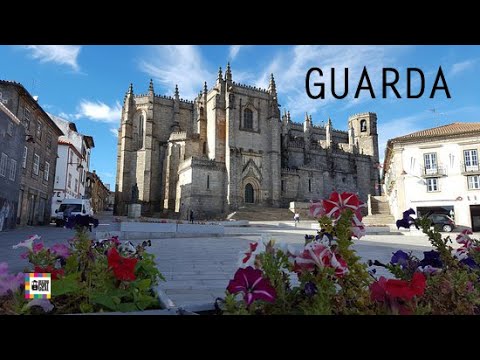
Guarda, Portugal
Guarda is a city and a municipality in the District of Guarda and the capital of the Beiras e Serra da Estrela sub-region in northern Portugal. The population in 2021 was 40,126, in an area of 712.10 square kilometres (274.94 mi2) with 31,224 inhabitants in the city proper in 2006. Founded by King Sancho I in 1199, Guarda is the city located at the highest altitude in Portugal and one of the most important cities in the Portuguese region of Beira Alta. Serra da Estrela, the highest mountain range in continental Portugal, is partially located in the district. The city is served by national and international trains on the Beira Alta and Baixa railway lines. The present mayor is Sérgio Costa, as an independent. The municipal holiday is November 27.
Guarda is the largest city in its district, capital of the Guarda District and the Beira Interior Norte Subregion within the Centro Region. The municipality is bordered by Pinhel to the north, to the east by Almeida, to the southeast by Sabugal, to the south by Belmonte and Covilhã, to the west by Manteigas and Gouveia, and to the northwest by Celorico da Beira. Guarda is the highest city in continental Portugal (altitude 1,056 m), located to the northeast of Serra da Estrela (the largest mountain in mainland Portugal). The main attraction in Guarda is its cathedral, known as the Sé da Guarda. Guarda is a diocese of the same name. Guarda railway station is served by the railway line Linha da Beira Alta, with international services towards Salamanca and Madrid, and domestic services to Pinhel, Vila Franca das Naves/Trancoso, Celorico da Beira, Gouveia, Nelas, Carregal do Sal, Santa Comba Dão, Mortagua, Luso/Buçaco and Pampilhosa. The station at Guarda has (2013) eighteen daily arrivals and departures of passenger trains and there is a small freight terminal. The section of the Linha da Beira Baixa which runs from Guarda through Belmonte/Sabugal, Covilhã, Fundão, Castelo Branco and Abrantes to Entroncamento is operating again, having been closed in 2010 between Guarda and Covilhã.
Guarda has a cool Mediterranean climate (Köppen: Csb) with some oceanic and continental influences. It has lower average temperatures than most climates of this subtype, in part due to its high altitude. Winters are cool and wet, and summers are warm and dry. Of the district capitals of Portugal, Guarda tends to experience the most snowfall, averaging about 12 days per year.
For a long time historians believed that the civitas Igaeditanorum (Egitania) was located in Guarda, but more recently it has been established that this location was in Idanha-a-Velha, in Beira Baixa. It was from here that the gentile "egitanian", in relation to the natives of the city, took root. Bordering the lands of the igaeditani, north of Guarda, were the lands of the Lancians Oppidani whose capital, the civitas Lancia Oppidana, was referred to as being located a short distance from the current location of Guarda. This theory was fiercely defended by General João de Almeida (influential Portuguese military man, hero of the African campaigns, native of Guarda), which has led some critics to disparage it. However, all the following investigations indicate its veracity. The place name "Guarda" may have been a derivation of a fortress overlooking the Mondego River, the Castro Tintinolho, whose place was called "Ward" by the Visigoths.
In 1655 the exploitation of tin mines in Guarda was intensified. In 1674, the diocesan synod of Guarda took place, in order to regulate tithes. Between 1728 and 1730, the Guardense doctor Simão de Castro was convicted of the inquisition in the city, for accusations of Judaism. As a result, he took refuge in Portuguese India, where he settled from 1734. In 1762-1763 the Guarda region was invaded by Spanish forces, during the Seven Years' War, and several towns in the area were occupied by Spain, including Almeida. This town was returned to Portugal in 1763, after the peace treaty signed in Paris. In 1801, the Marquis of Alorna built bunkers in Guarda, against bomb attacks, after the deterioration of diplomatic relations with Spain. That same year, the first section of the walls was demolished, on the orders of Alorna Marqués, in order to reuse its stone in the construction of a fort in the neighboring town of Vale de Estrela, to the west of the city. As a result of the Napoleonic invasion of Portugal, with troops commanded by the French general Loison, a revolt took place in Guarda on June 21, 1808, after the transfer of the Portuguese court to Brazil as a result of these invasions. The March 22, 1811, the French general André Masséna decided to concentrate the French army around Guarda and Belmonte, far from the fortresses of Ciudad Rodrigo and Almeida. On April 3 of the same year, at the Battle of Sabugal, the British General Wellington won against General Jean Reynier, and forced Masséna to leave Portugal. After the particularly severe devastations caused in the Diocese of Guarda and its neighboring Diocese of Pinhel (currently also in the district of Guarda), these two dioceses were, in Portugal, until August 1811, the third and fourth most benefited by donations to the victims of the third French invasion of Portugal led by Masséna, just behind Leiria and Lisbon.
Prehistory
There is evidence of a meteorite impact in the region, northeast of Guarda, with about 35 km in diameter. Some pre-Ordovician evidence (from the Cambrian period, the earliest Phanerozoic epoch) is present.
From the Neolithic to the Christian Reconquest
In the first centuries of the Romanization of the Iberian Peninsula, Lusitanian tribes lived in the Guarda region. These tribes included, namely, the Igaeditani, the Lancienses Oppidani, and the Transcudani. These peoples, united under a true federation, resisted Romanization for two centuries. Unlike the Latinized towns, these towns did not consume wine, but instead, acorn beer. His weapon of choice was the falcata: a curved sword, which easily broke Roman swords due to its metallurgical superiority. Their pagan gods also differed from the Romans. Some Lusitanian religious inscriptions can still be found in some sanctuaries such as Cabeço de Fráguas. It is argued that the ancestral town of Castelos Velhos, from the Iron Age, was located in the current city of Guarda.
Burgundy dynasty
The city of Guarda was founded in 1199, in a location that was both difficult to reach and allowed as many as twenty leagues of the surrounding territory to be watched, and Sancho I of Portugal transferred the diocese of Egitania (modern day Idanha-a-Velha) to Guarda, while granting the city a charter that was based on the short charter of Salamanca. Situated high up, the city had a remarkable defensive and strategic importance. The Jewish quarter of the city, which already had some importance back in the 13th century among the communities of the kingdom of Portugal, was between 600 and 850 people in the 15th century, and hosted a significant number Jews expelled from Spain in 1492.
1383–1385 Portuguese interregnum and House of Aviz
In 1371, Denis granted in Guarda a "land of refuge" for the "humanized", who were the people convicted of murder, whom the king pardoned certain crimes or misdemeanors, with the aim that they would settle in the lands near borders. In 1383 a college for poor students was created in the city by Bishop Afonso Correia II, associated with the Episcopal school of Guarda, existing since (at least) the 13th century. In 1465 King Afonso V made new Courts in Guarda, where the judges of the Civil Chamber were forbidden to disembark facts related to the city of Lisbon and whose resolutions were exclusive powers of the king. In 1475, Prince John (future King John II) led a Council in Guarda to gather the troops that would participate in the Battle of Toro, within the course of the War of the Castilian Succession. In the 1490s, when the expulsion of the Jews from Spain happened, Guarda received new inhabitants for its Jewish community, who would bring a new life to commerce in this border area. In 1493, the born and resident of Guarda, Rui de Pina, planned the Treaty of Tordesillas and set out on a diplomatic mission to Castile. In 1496 and 1497, during the reign of Manuel I, the conversion or expulsion of the Jews was ordered, which led to the appearance of the so-called New Christians (or Marranos), and as well as the expulsion of the moors, dand or place to the appearance of crypto-Judaism in the region. On October 22, 1536, the Inquisition began, and the persecution against Hindus (in Portuguese India), Muslims and Jews was launched. The persecutions were also launched in Guarda, particularly as of June 8, 1564, when authorization was given to D. Ambrosio Capelo, inquisitor of Guarda, to conduct the inquisition in the dioceses of Guarda and Lamego.
Portuguese succession crisis of 1580
In 1580, during the course of the dynastic crisis of 1580, the Bishop of Guarda, D. João, took sides for the independence of Portugal and opposed Philippine rule. The bishop then resisted the outcome of the Battle of Alcântara and continued to side with António, Prior of Crato, contrary to all the other Portuguese bishops. On March 18, 1582, the Pope condemned the "excesses" committed by D. João, bishop of Guarda, and he died in 1592 under the rule of Philip II of Spain (Philip I of Portugal).
Iberian Union
On September 21, 1597, the synod was held in which new statutes or constitutions of the bishopric of the city began, in order to accommodate the decrees of the Council of Trent, in the context of the Counter-Reformation of the Catholic Church.
The gastronomy of Guarda is associated with the gastronomy of the Serra da Estrela. Some of the most outstanding typical dishes are the following: roast lamb, rice with duck in the Guarda way, and Lagareiro cod, which can be easily found in regional cuisine restaurants. The gastronomy of the city includes a wide range of meat-based dishes, given the geographical location of the city, as well as the surrounding lands, which are conducive to grazing. There is also a wide variety of fish dishes from freshwater streams. Cod is the exception, since its conservation process (by drying) has always allowed its consumption in lands far from the sea. The pig occupies an important place in the local gastronomy, with countless dishes made with this type of meat. The ham cured in sea salt can be highlighted, as well as the typical local cured meats (black pudding, farinheira and chouriço), such as tripe with vegetables. Other common meats are lamb, goat, beef, and white meat. Carquesa (Genista tridentata) rice is also a very typical dish in the city and the region.
A medieval temple built in Gothic and Manueline styles. Its restoration, carried out by the architect Rosendo Carvalheira, took place between 1899 and 1921. The castle was declared a National Monument on June 16, 1910. Its construction, supposedly on a Roman-Lusitanian fort from the 1st century, took place between the 12th and 14th centuries.
The main economic sectors of Guarda are: tourism, textiles, electric wire and cable industry for automobile manufacturing and for energy industries, wood, glass, marble and granite processing, metallurgy, aluminum manufacturing, chemical products, blinds, cold cuts, bakery and pastry, dairy industry, as well as construction companies. There are also handicraft activities and agricultural and agro-livestock activities in the rural environment of the municipality.
The main football club in the city is Guarda Unida, which participates in the first district division in the 2014-2015 season. Other clubs and associations of this type in the city include the Guarda Mountaineering Club, founded in 1981, The Pinheiro Center for Sport, Culture and Social Solidarity, integrated into the Guarda Athletics Association, the CSS - Associação de Desenvolvimento Carapito S. Salvador and the Lameirinhas Sports and Recreation Group, dedicated to futsal.[citation needed]
The municipality consists of the following 43 parishes: