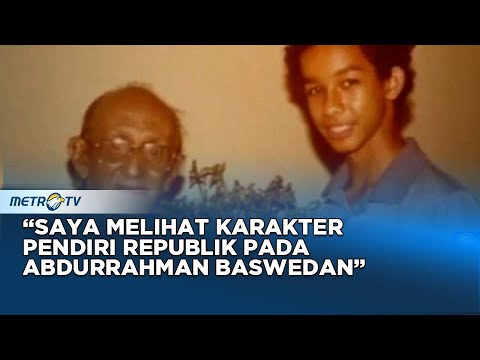
Abdurrahman Baswedan
Abdurrahman Baswedan, also known as AR Baswedan was a nationalist, journalist, Indonesian freedom fighter, diplomat, and writer. Baswedan was a member of the Central Advisory Council during the Japanese occupation of the Dutch East Indies and of the Investigating Committee for Preparatory Work for Independence (BPUPK), served as Deputy Minister of Information of the Third Sjahrir Cabinet, a member of the Central Indonesian National Committee Working Group, a member of parliament, and also a member of the Indonesian Constitutional Assembly. Baswedan was one of Indonesia's first diplomats who successfully gained de jure and de facto international recognition for the Republic of Indonesia. He was awarded the title of National Hero of Indonesia in 2018.
Imagem: Muhammad Husnil · BY-SA · Openverse
In August 1934, Semarang based daily newspaper "Matahari" published an article on Indonesians of Arab descent, calling them to unite in supporting Indonesia's independence. Baswedan himself was of Arab descent, but he spoke with a strong East Javanese accent. He called for people of Arab descent living in Indonesia to adhere to the principle: "di mana saya lahir, di situlah tanah airku." (Where I was born, is where my homeland is) His picture on the article conveyed the message strongly as he was wearing a blangkon (Javanese traditional hat). On 4 October 1934, after the publication of an article, accusing Arab-Indonesians of supporting the Dutch colonists, Baswedan gathered ethnic Arabs in Semarang. In the gathering, they declared the Arab-Indonesian Youth Pledge, which proclaimed Indonesia as their motherland, and their commitment to support the fight for Indonesia's independence. In repercussion to the congress, the Indonesian Arab Party (Partai Arab Indonesia, PAI) was established and Baswedan was elected as its chairman. To focus on the political struggle, he left his well-paid job at the Matahari daily newspaper being paid 120 guldens, worth 24 quintal of rice.
Imagem: Makamindo · BY-SA · Openverse
Baswedan was a tough journalist who worked not for money. His decision to leave Matahari was not the only display of his commitment. He moved from the Sin Tit Po Newspaper which paid him 75 gulden to dr. Soetomo's Soeara Oemoem which only able to pay him 10-15 gulden. For his exemplary character, Soebagio IN put him in the list of 111 Indonesia's national press pioneers. As a patriot-journalist, Baswedan wrote actively. He was widely known as a writer, poet, and artist. His speech attracted many and he was also an expert in drama art. Apart from Bahasa Indonesia, he mastered Arabic, English, and Dutch. Some of his published books are Debat Sekeliling PAI (Debates Surrounding the Indonesian Arab Party, 1939), Sumpah Pemuda Indonesia Keturunan Arab (Youth Pledge of Arab Indonesians, 1934), and Rumah Tangga Rasulullah (The Prophet's Household, 1940). He also wrote a five-stage drama story titled Menuju Masyarakat Baru (Toward a New Society). Other than his own publications, his ideas and visions were published by the secretary general of PAI, Salim Maskati.
His struggle continued in the new Republic. Together with Haji Agus Salim (Deputy Minister of Foreign Affairs), Rasyidi (Secretary General of the Ministry of Religious Affairs), Mohammad Natsir and St. Pamuncak, AR Baswedan departed to Arab countries as Indonesia's first diplomatic delegation. The delegation gained historical success with Egypt becoming one of the first countries to give de facto and de jure recognition to the fledgling Republic. This diplomatic success, after long negotiation in the Arab League, was soon followed by recognition by other countries.[citation needed]
Imagem: Makamindo · BY-SA · Openverse
Baswedan was born on 9 September 1908 in Ampel Village, Surabaya, as the third of four sons of Awad Baswedan (1879–1925), an Arab-Indonesian Muwallad of Hadhrami descent from a non-Sayyid family, and Aliyah binti Abdullah Jarhum (died 1918). His brothers were Ibrahim (1901–1944), Ahmad (1902–1964), and Umar (1914–1976). Baswedan also had two half-brothers, Abdullah (1914–1950) and Salim Baswedan (born 1916), and a half-sister, Mariam (1920–1987), from his father fourth marriage to Halimah. His paternal grandfather, Umar bin Muhammad bin Abdullah, immigrated from Yemen to Dutch East Indies. He received his early education at Madrasah Al-Khairiyah near Ampel Mosque in Surabaya, later continued his education under Sheikh Ahmad Surkati at the al-Irshad school in Batavia. Not finishing his studies at al-Irshad, he went back to Surabaya to be close with his father and studied with Sayyid Ahmad bin Hashim at the Hadhramaut School in Surabaya, where pro-sayyid practices such as taqbil was maintained. He became active at al-Irshad in Surabaya in the late 1920s, but resigned from his executive position of its Youth wing in June 1930.